The Three Maps
The book proposes three interdependent lenses for understanding the living body. None is complete alone. Braided together, they reveal an architecture richer than any single map can yet contain.
Structure
Fascia, tensegrity, the continuous mesenchymal sheet
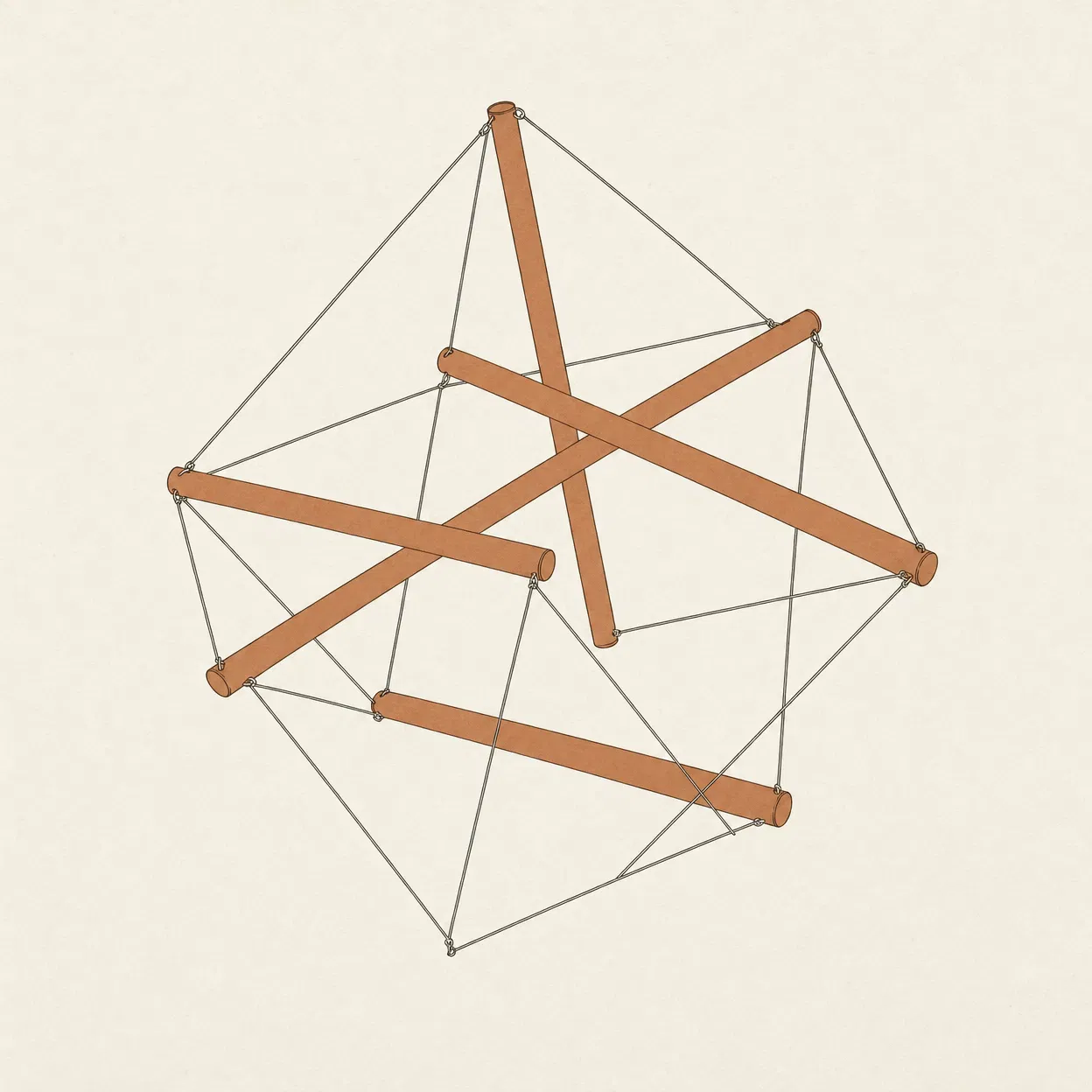
The trail behind my house in the East Bay hills is steep and unforgiving. Months after the accident, I tried to run it again. Within a minute the familiar lag returned. My left leg pushed off, but the force did not travel cleanly up the chain. Instead it caught, dispersed sideways, as if the whole structure were negotiating every step under new and invisible loads.
One useful way to understand this is through the principle of prestress. In living systems, tissues exist under constant, distributed tension. Stephen Levin borrowed Buckminster Fuller's tensegrity concept and applied it to biology: bones as discontinuous compression elements floating inside a continuous tension network of fascia, ligaments, and muscles. Remove the tension and the system collapses. Add too much in one direction and compensations ripple everywhere.
Fascia itself behaves like a smart material. Under load it can store elastic energy like a spring, then release it in spirals and crossed diagonals that amplify power while protecting joints. When that braid is disrupted, the stored force has nowhere clean to go. It pools. It creates drag. It turns ordinary movement into constant negotiation.
We may be less assembled than woven — held upright less by rigid bones and more by dynamic equilibrium in a sea of tension.
From the manuscript, Chapter 5
Flow
Lymphatic rivers, the second circulation, drainage and immune surveillance
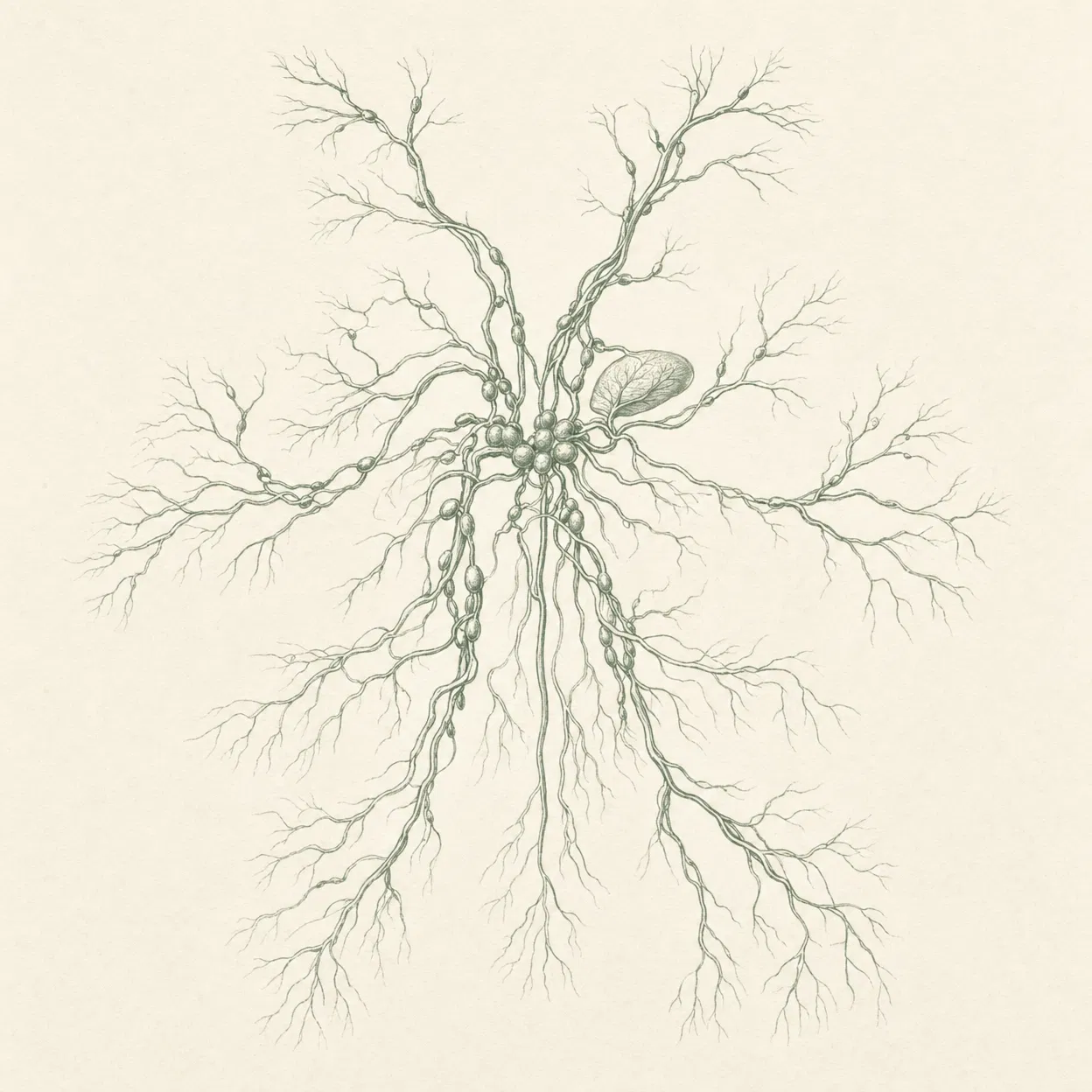
The lymphatic system remains one of the least mapped major networks in the body. A vast, low-pressure river system charged with fluid balance, immune surveillance, and waste clearance, it depends on movement, breathing, and tissue tension to keep moving. Alter those rhythms and the flow does not simply stop at the injury site. It braids new, inefficient channels or pools in subtle eddies that standard scans rarely reveal.
Traditional Chinese Medicine describes the body as a network of pathways called meridians that carry vital information and flow in continuous lines across the entire form. The San Jiao, often translated as the Triple Burner, functions as a system of "waterways" regulating fluid movement, drainage, and metabolic balance — functions that parallel, in intriguing ways, the lymphatic network's role. What Western medicine calls lymphatic congestion appears in TCM as "dampness" or obstructed flow.
The rivers are slow here.
From the manuscript, Chapter 4
Field
Emergent coordination, bioelectricity, morphogenetic patterning
I was sitting on the edge of the bed one quiet morning, palms on my knees, doing nothing. For the first time since the accident I simply felt the body without judgment. A subtle wave moved through the left side — warm, organizing, almost intelligent. It was not pain and it was not relief. It was pattern remembering itself.
Developmental biologists have long spoken of morphogenetic fields — regions of coordinated influence that guide cells into coherent structures during embryogenesis. Modern research frames these as measurable biophysical realities: mechanical tension gradients, ion flows, and electrical patterns that direct growth, regeneration, and even large-scale anatomy. These emerge from the continuous conversation between mechanical tension in the extracellular matrix, pressure gradients in the lymphatic rivers, and the prestressed cytoskeleton inside every cell.
Healing, then, may be less about forcing parts back into place and more about restoring the conditions under which the body's own intelligence can do what it has always done: organize, balance, remember.
The body was not a broken machine waiting for repair. It was a living, self-organizing conversation asking to be heard.
From the manuscript, Chapter 10